Winds of Desire
Chris Wisniewski on Ashes of Time Redux
In 2008, Wong Kar-wai followed the disappointment of My Blueberry Nights by returning to one of his earlier films, 1994’s spottily available Ashes of Time. Since its initial release, the film had floated around in various versions. Wong excavated, reassembled, and revisited Ashes, piecing it together with raw material from sources around the globe. The resulting Redux included a few minutes of new footage, credit sequences, digital effects, and a rearranged score, with some additional music (courtesy of Wu Tong). And though it may not differ as markedly from the original as Coppola's Apocalypse Now Redux did, it nevertheless remains an unqualified triumph, the kind of cinematic experience that reminds audiences why they fell in love with Wong in the first place, whether they’re rediscovering the film or seeing it for the first time.
A generic oddity in his oeuvre, Ashes of Time was the director’s only attempt to date at a wuxia picture. In writing the screenplay, Wong took his source material, Louis Cha’s The Eagle-Shooting Heroes, as his endpoint, fashioning a prologue that charts how Cha’s two protagonists came to be the Lord of the West and the Lord of the East. The former, Ouyang Feng (the late Leslie Cheung) begins Ashes of Time as a liaison between bounty-hunter swordsmen and the people commissioning them. Huang Yaoshi (Tony Leung Ka Fai), the future Lord of the East, visits Ouyang annually—for reasons that eventually become clear by film’s end—until he drinks a magic wine that causes him to forget his past. Ouyang narrates the story himself, which travels circularly, essentially beginning and ending with Huang drinking the lacuna-inducing wine.
Ashes of Time Redux has a few genuinely dazzling martial-arts sequences—most memorably, Tony Leung Chiu Wai’s fateful battle with a gang of bandits, which ends with blood gushing from a slit throat with a gaping, existential sigh, and Brigitte Lin’s extraordinary swordplay on a lake, the water dancing to the heavens. Nevertheless, despite its wuxia trappings, the movie may have more in common with Wong’s other films than with those of its genre. “The root of men’s problems,” Ouyang explains at the beginning of the film, sounding like a character plucked right out of 2046, “is memory.” Ashes is told in five parts, corresponding to five seasons of the Chinese almanac, and with each successive season, it becomes an increasingly dismal tale of unrequited loves—each character can’t seem to let go of somebody who loves somebody else, and each is running from their love, away from memory, instead towards blissful forgetting or self-annihilation. Ouyang and Huang occupy the nexus of the film’s various love triangles, and their skills as swordsmen seem comparatively incidental next to their various romantic yearnings. It’s your standard issue Wong romantic drama dressed up, not as a period piece or gangster picture, but instead as a martial-arts epic.
But the word “epic” hardly seems to fit Ashes of Time Redux. The film is told mostly in wide-angle close-up, giving it an intimate scale and a human focus. This is a film of faces and gestures, not of expansive terrain or large-scale battles. In a brisk hour and a half, Wong downplays incident, including a few extended sequences of pure mood (a few times, Wong's camera lingers on Carina Lau as she pets her horse . . . emphatically . . . at length). The film has neither the size nor the momentum of a traditional epic or action picture—martial arts or otherwise—and there’s a laxness to the storytelling. The film has at least four major romantic subplots, but they're underdramatized to the point of being a bit difficult to follow.
Yet Ashes still manages to pack an emotional wallop through the cumulative effect of its various vignettes. Brigitte Lin’s descent into madness, in particular, is beautifully rendered by both the actress and the filmmaker; at one point, she seduces Cheung’s Ouyang in a hallucinatory sequence in which identity seems to become mutable and unstable, an effect established mostly through simple but superbly elegant editing. Maggie Cheung, meanwhile, brings gravity and focus to the final half hour of the film. Narratively, she serves as the linchpin between the Lord of the East and the Lord of the West, and her appearance makes sense of Wong’s tricky chronology. More importantly, she manages, with minimal screen time, to give the film an emotional center that it might otherwise lack. She brings the whole thing into focus, providing as lovely a portrait of longing and loneliness as Wong has ever captured.
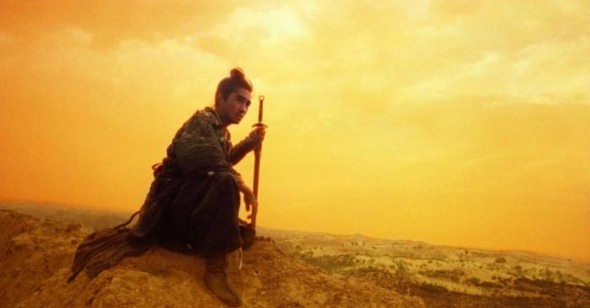
If Ashes of Time is cut from the same thematic cloth as Wong's more recent work, including In the Mood for Love or 2046 or, yes, My Blueberry Nights, it also shares the distinctive visual sensibility that marks Wong’s finest collaborations with director of photography Christopher Doyle (Kwan Pun-leung is credited with the additional photography for Redux). The slow-motion that’s become the Wong-Doyle trademark seems in a few sequences to almost resemble pixilation, and the close-up/wide-angle photography is clearly of a piece with their other mid-nineties output, including Chungking Express and Fallen Angels. The film’s heavily brown, green, and yellow color palette contributes to its generally earthy, washed-out look. This is, from first frame to last, a fully realized work of action cinema, a movie as visually arresting as it is emotionally stirring, one that could only be appreciated, in terms of its visual accomplishment, on a big screen.